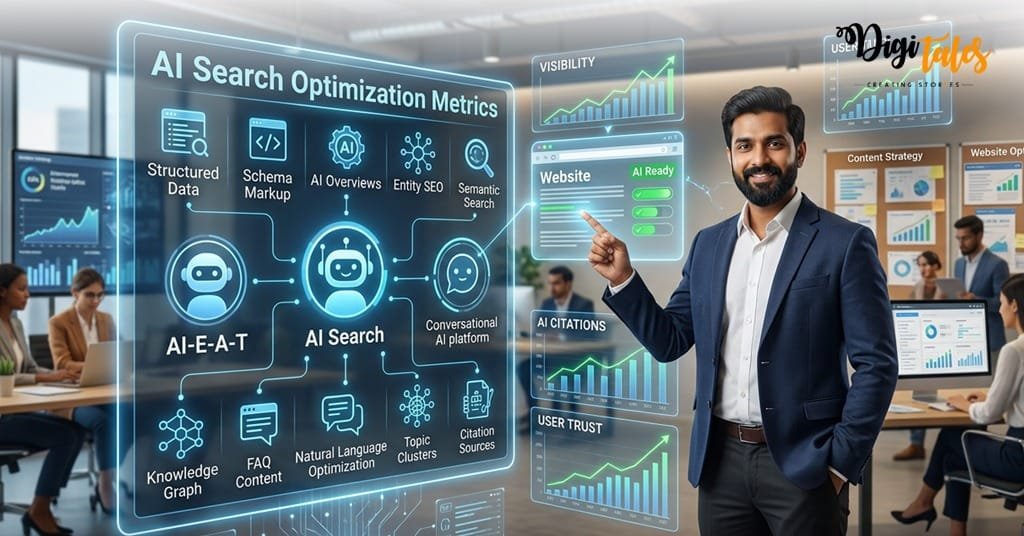





AEO vs SEO vs GEO: What’s the Difference and Why Your Business Needs All Three
A significant change in online search behavior occurred in just a few years. Rather than going through several pages of search results, users now rely on Google AI Overviews ChatGPT Gemini, Perplexity, and other voice assistants to give them immediate answers. This means that companies cannot depend only on conventional SEO to stay seen.
Current search optimization is based on three interdependent tactics: Search Engine Optimization (SEO), “Answer Engine Optimization”, and “Generative Engine Optimization”. Although they all work towards making your company stand out from the crowd, every strategy plays a distinct role in making sure your potential customers find your products or services.
If you’ve been contemplating “GEO vs SEO” or are still unclear where “AI SEO” is supposed to fit in, this guide will explain everything.
What Is SEO?
Search Engine Optimization (SEO) is the process which consists in optimizing a web pages to be listed higher in organic (non-Paid) Search Engines Results like Google and Bing. Through SEO you get to the point where your contents correspond precisely to what your audience is looking for when they are online. As a consequence, a higher search engine result ranking brings more visitors to your website without paying for the advertisement.
SEO has proven to be the base of digital marketing and that’s because through it, companies are able to connect with the right customers while these are actively looking for the products, services or information. Even so, nowadays people’s use of online search has expanded well past just looking at classic search engine result pages.
An effective SEO plan should cover this areas:
1. Study of keywords
2. Producing compelling content
3. Making your web site perform better technically
4. Mobile compatibility
5. Cross linking your pages
6. Creating backlinks pointing back to your site
7. Optimizing web pages to load quickly
To wrap up, SEO is still very important but it should not be considered as the only technique for a comprehensive search strategy.

What Is Answer Engine Optimization (AEO)?
AEO is the art of Answer Engine Optimization, i.e. crafting such quality and helpful content so that it becomes the answer of choice to a user query, directly and without going through a search webpage. AEO goes beyond traditional search ranking strategies; it tailors the content for AI Overviews, voice assistants, Featured Snippets, and other answer-focused channels.
Let’s take a look at AEO in action. Suppose someone types into Google search the question “What is AI SEO?” Instead of presenting a list of 10 relevant websites related to AI SEO, the engine will most likely display the condensed content of the direct answer first. It is the essence of AEO to make the source of that concise information your content. In the same vein, if the user asks questions like “What are the best SEO tools for AI?” or if they’re asking for opinions like “What should an AI SEO do, as the best experts in the industry?”, the search engines are able to provide a summary of the top answers, sometimes highlighting those very answers as well, which the user might want to click to for detailed answers.
There aren’t any magic formulas of AEO; just good, informative, and well-documented answers will help the search engines highlight and summarize them more accurately. Here are some of the things you can do to enhance your chances of being listed on search answer engines:
1. Use questions in your content headings.
2. Provide answers in a clear and concise manner. Related articles: SEO for Google Voice Assistant, How to Get Voice Commands Work on Smart Speakers.
3. Create FAQs sections for a list of the most commonly asked questions.
4. Include structured markup like Schema to help machines understand your data better.
5. Use logical headings that divide your content in a meaningful way.
6. Present your thoughts in short, easily digestible paragraphs for better readability.
What Is Generative Engine Optimization (GEO)?
SEO mainly aims at increasing Google rankings while AEO directly brings an answer to each query. By contrast, “Generative Engine Optimization” is about making your content ready for AI-powered platforms like ChatGPT Gemini Claude, Copilot, and Perplexity.
The thing is, these chatbot-like platforms don’t just show you a list of search results; they actually generate responses based on analyzing and combining information from different trusted sources. If you’re the type of business that consistently produces authoritative, well-structured, and trustworthy content, AI algorithms from the likes of Google, Google and ChatGPT tend to cite you.
Major generative engine optimization techniques are:
1. Developing thorough, original content
2. Creating topical authority
3. Proving expertise and experience
4. Publishing reliable and updated information regularly
5. Adopting a logical layout and clear section headings
6. Obtaining high-quality backlinks and brand mentions
As AI-driven search grows, the importance of GEO will match that of traditional SEO.

GEO vs SEO: What’s the Difference?
Many businesses compare “GEO vs SEO”, assuming they’re competing strategies. In reality, they solve different problems.
| SEO | AEO | GEO |
| Optimizes for search engine rankings | Optimizes for direct answers | Optimizes for AI-generated responses |
| Focuses on organic website traffic | Focuses on visibility in answer engines | Focuses on AI recommendations and citations |
| Uses keywords, links, and technical optimization | Uses concise, question-based content | Uses authority, context, and trust |
| Best for Google Search | Best for AI Overviews and voice search | Best for ChatGPT, Gemini, Perplexity, and other AI platforms |
Why Your Business Needs All Three
SEO mainly aims at increasing Google rankings while AEO directly brings an answer to each query. By contrast, “Generative Engine Optimization” is about making your content ready for AI-powered platforms like ChatGPT Gemini Claude, Copilot, and Perplexity.
The thing is, these chatbot-like platforms don’t just show you a list of search results; they actually generate responses based on analyzing and combining information from different trusted sources. If you’re the type of business that consistently produces authoritative, well-structured, and trustworthy content, AI algorithms from the likes of Google, Google and ChatGPT tend to cite you.
Major generative engine optimization techniques are:
1. Developing thorough, original content
2. Creating topical authority
3. Proving expertise and experience
4. Publishing reliable and updated information regularly
5. Adopting a logical layout and clear section headings
6. Obtaining high-quality backlinks and brand mentions
As AI-driven search grows, the importance of GEO will match that of traditional SEO.
Where AI SEO Fits Into the Picture
“AI SEO” isn’t really a replacement for SEO.
It’s an evolution of it that adds traditional search engine optimization techniques to strategies that optimize for search engines and AI platforms alike to be able to generate content responses.
The main idea behind AI SEO is to not only create content for a search engine but also an entire landscape of search engines and user experiences.
Top AI SEO practices are:
- Finding ways to rank on various search engines
- Catering to generative ai search results
- Voice search optimization
- Cater to your customers first
- Establishing a credible website
By following this approach, the company will remain visible to customers irrespective of the type of technology or search they might use.
Best Practices for Modern Search Optimization
The most successful businesses don’t optimize for only one platform. They create content that serves users wherever they search.
To build a future-ready strategy:
- Write comprehensive, people-first content.
- Focus on solving customer problems instead of chasing keywords.
- Structure articles with clear headings and logical flow.
- Answer common questions naturally throughout your content.
- Maintain technical SEO best practices.
- Demonstrate expertise through original insights and real-world experience.
- Refresh existing content regularly to keep it accurate.
- Build authority through quality backlinks and brand credibility.
These practices strengthen your presence across search engines, answer engines, and AI-powered platforms alike.
Final Thoughts
Search results have become more complex because just seeing blue links from Google is no longer the case anymore. Customers want to get quick and verified replies whenever they are typing in Google, speaking to ChatGPT, or just checking out Gemini and Perplexity platforms.
That’s the reason why learning how to use “GEO and SEO” is no longer sufficient for business success. Companies also need to implement “Answer Engine Optimization” and “Generative Engine Optimization” as part of an integrated approach.
The companies that will dominate in this era are those that offer reliable and structured content. Combining traditional SEO with latest AI practices will help you not just to rank higher online but also prepare for the new way of search that will appear one day.